



Introduction
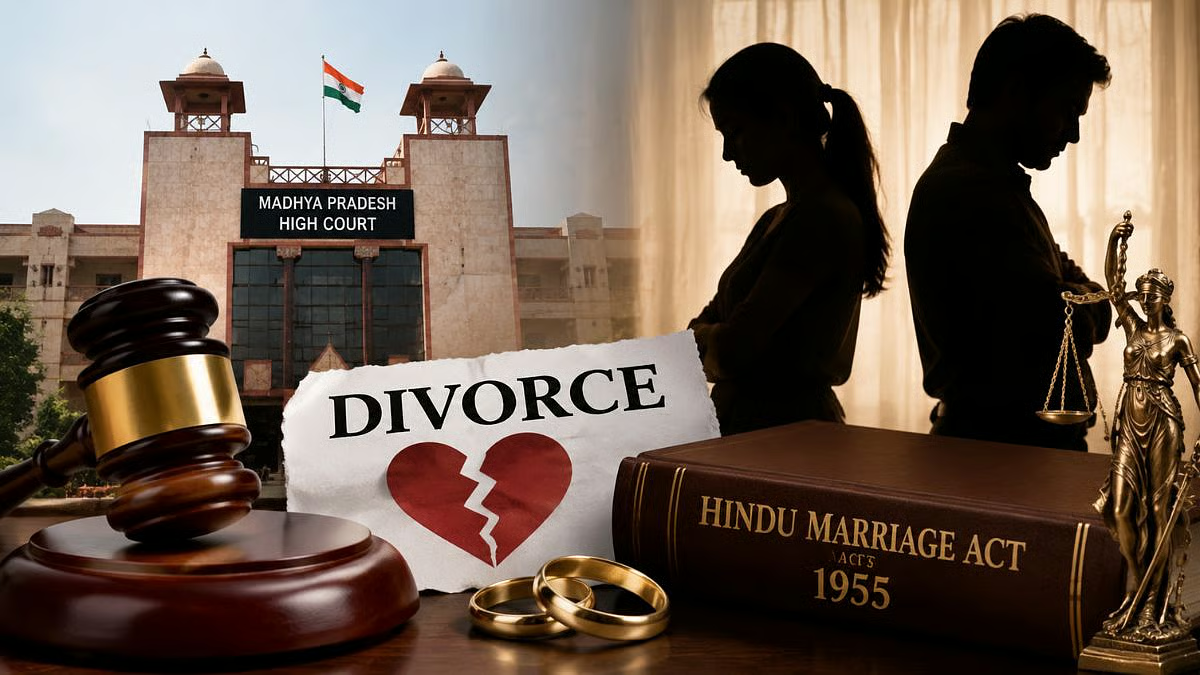
In a significant matrimonial law judgment, the Madhya Pradesh High Court held that a spouse who voluntarily abandons the matrimonial home without sufficient justification and is found to have engaged in an extramarital relationship cannot seek divorce by taking advantage of her own conduct. The Court observed that matrimonial relief must be granted in accordance with the provisions of the Hindu Marriage Act, 1955, and not in favour of a party whose own actions contributed to the breakdown of the marriage.
Background of the Case
The dispute arose from a divorce petition filed by the wife, who sought dissolution of her marriage on various grounds. During the proceedings, evidence was led regarding the circumstances under which she had left the matrimonial home.
The husband contended that the wife had voluntarily deserted him without any reasonable cause and had subsequently entered into an extramarital relationship. Based on the evidence presented, the Family Court dismissed the wife’s petition, following which the matter reached the Madhya Pradesh High Court.
Court’s Key Observations
The Madhya Pradesh High Court observed that:
- The wife had voluntarily left the matrimonial home without establishing sufficient legal justification.
- The evidence on record supported the finding that she had entered into an extramarital relationship after leaving the matrimonial home.
- A party cannot seek matrimonial relief by relying on circumstances created by his or her own wrongful conduct.
- Divorce cannot be granted merely because the marriage has become strained when the statutory grounds are not satisfied.
Principle That One Cannot Benefit From One’s Own Wrong
The Court reiterated the well-established legal principle embodied in matrimonial law that a person cannot take advantage of his or her own misconduct.
According to the Court:
- Relief under the Hindu Marriage Act is discretionary and depends upon the facts of each case.
- Where the conduct of the petitioner is responsible for the matrimonial dispute, the Court may refuse to grant relief.
- Courts must carefully evaluate the evidence before dissolving a marriage.

Importance of Evidence in Matrimonial Cases
The High Court emphasized that allegations such as desertion or extramarital relationships must be decided on the basis of evidence placed before the Court.
The Bench observed that:
- Matrimonial disputes cannot be decided on assumptions or mere allegations.
- Findings regarding the conduct of the parties must be supported by the evidence on record.
- Each case must be determined on its own facts and circumstances.
Court’s Decision
The Madhya Pradesh High Court upheld the Family Court’s decision and refused to grant a decree of divorce to the wife. It concluded that, in the facts of the case, the petitioner was not entitled to matrimonial relief, as the evidence showed that she had voluntarily left the matrimonial home and could not seek to benefit from her own conduct.
Significance of the Judgment
This ruling is important because it:
- Reaffirms the principle that no person can take advantage of his or her own wrong.
- Highlights the importance of evidence in deciding matrimonial disputes.
- Clarifies that divorce can be granted only when the statutory requirements under the Hindu Marriage Act are satisfied.
- Emphasizes that courts will examine the conduct of both spouses before granting matrimonial relief.
- Reinforces that each matrimonial dispute must be decided on its individual facts.
Conclusion
The Madhya Pradesh High Court’s judgment reiterates that matrimonial relief is governed by legal principles and evidence, not merely by the desire to end a marriage. By refusing divorce in the present case, the Court reaffirmed that a spouse who voluntarily leaves the matrimonial home without sufficient cause and is found to have contributed to the marital breakdown through wrongful conduct cannot ordinarily seek relief by relying on that very conduct. The decision underscores the importance of fairness, evidence, and statutory requirements in matrimonial proceedings.
