



Introduction
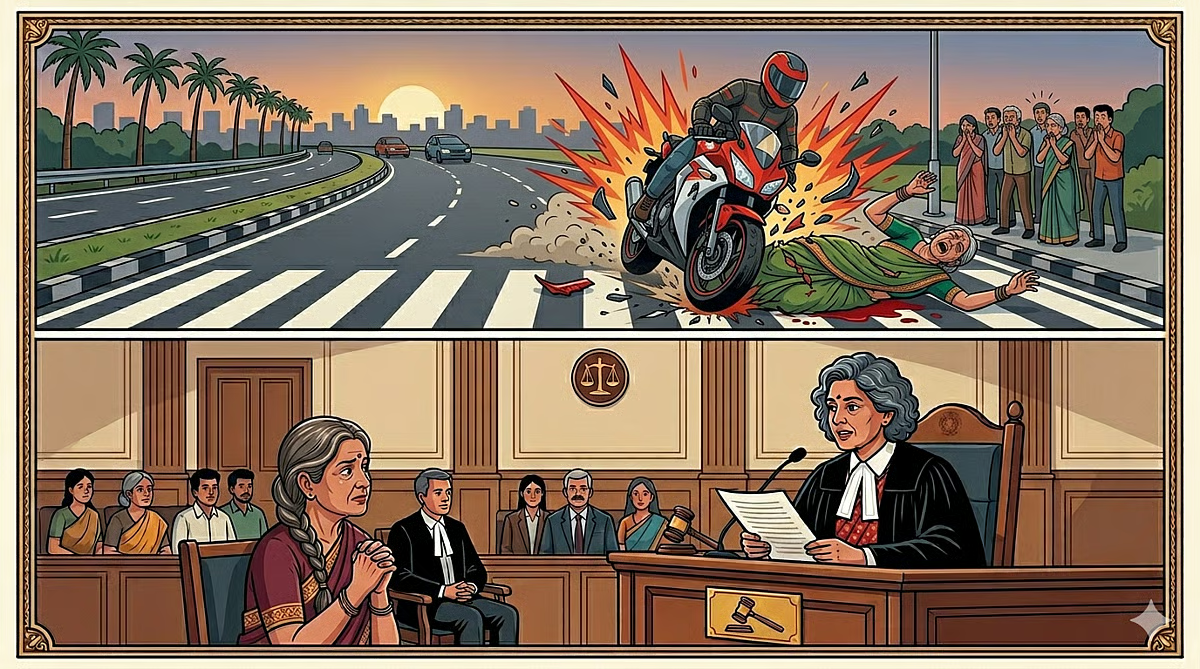
In a significant ruling under motor accident compensation law, the Kerala High Court has held that adult siblings are not automatically disqualified from claiming compensation for “loss of dependency” merely because they have attained majority.
The Court clarified that if an adult sibling can establish genuine financial dependence on the deceased through credible evidence, compensation may be awarded under the Motor Vehicles Act.
Background of the Case
The case arose from a motor accident claim involving the death of an individual who was allegedly providing financial support to family members, including an unmarried sister.
The insurance company challenged the compensation awarded by the Motor Accidents Claims Tribunal, arguing that a major sibling could not be treated as a dependent for the purpose of calculating compensation.
The dispute eventually reached the Kerala High Court for determination of whether an adult sister could claim compensation for loss of dependency.
Court’s Key Observation
The Kerala High Court observed that:
- Dependency is a question of fact and not merely a matter of age.
- A person does not cease to be financially dependent solely because they have attained majority.
- Courts must examine the actual financial relationship between the deceased and the claimant.
- If evidence establishes dependence, compensation cannot be denied merely because the claimant is an adult sibling.
The Court emphasized that the purpose of compensation is to address the actual financial loss suffered by dependents following the death of a breadwinner.
Financial Dependency Must Be Proved
The Bench clarified that not every sibling automatically qualifies as a dependent.
According to the Court:
- The claimant must produce evidence showing financial reliance on the deceased.
- Dependency may be established through circumstances such as regular financial support, lack of independent income, or other relevant facts.
- Mere relationship with the deceased is insufficient without proof of actual dependence.
The Court noted that compensation should reflect the realities of family life rather than rigid assumptions based solely on age.
Recognition of Modern Family Structures
The judgment acknowledged that in many families, earning members support adult brothers, sisters, and other relatives.
The Court observed that:
- Financial dependence can continue beyond childhood.
- Unmarried, unemployed, or economically vulnerable siblings may rely on a family member for their livelihood.
- Compensation law should recognize genuine dependency wherever it exists.
The Bench stressed that legal principles must be applied in a manner consistent with social and economic realities.
Court Upholds Award to Unmarried Sister
After examining the evidence on record, the High Court found sufficient material to establish that the deceased’s unmarried sister was financially dependent on him.
The Court therefore upheld the compensation awarded under the head of loss of dependency and rejected the challenge raised against the award.
Importance of the Ruling
This judgment is significant because it:
- Clarifies that adult siblings can be considered dependents in appropriate cases.
- Emphasizes evidence-based assessment of financial dependence.
- Prevents arbitrary denial of compensation based solely on age.
- Recognizes changing family and economic realities in compensation law.
Impact on Motor Accident Claims
The ruling is likely to influence future compensation cases by reinforcing that:
- Dependency must be determined on facts rather than assumptions.
- Adult family members may claim compensation if genuine dependence is established.
- Courts should focus on actual financial loss suffered by claimants.
This approach ensures that compensation serves its intended purpose of providing relief to those who were truly dependent on the deceased.
Conclusion
The Kerala High Court’s decision reinforces the principle that financial dependency is not determined solely by age or legal status. By upholding compensation for an unmarried adult sister who was financially dependent on the deceased, the Court has emphasized that motor accident compensation should be guided by real-life circumstances and substantive justice rather than technical distinctions.
