



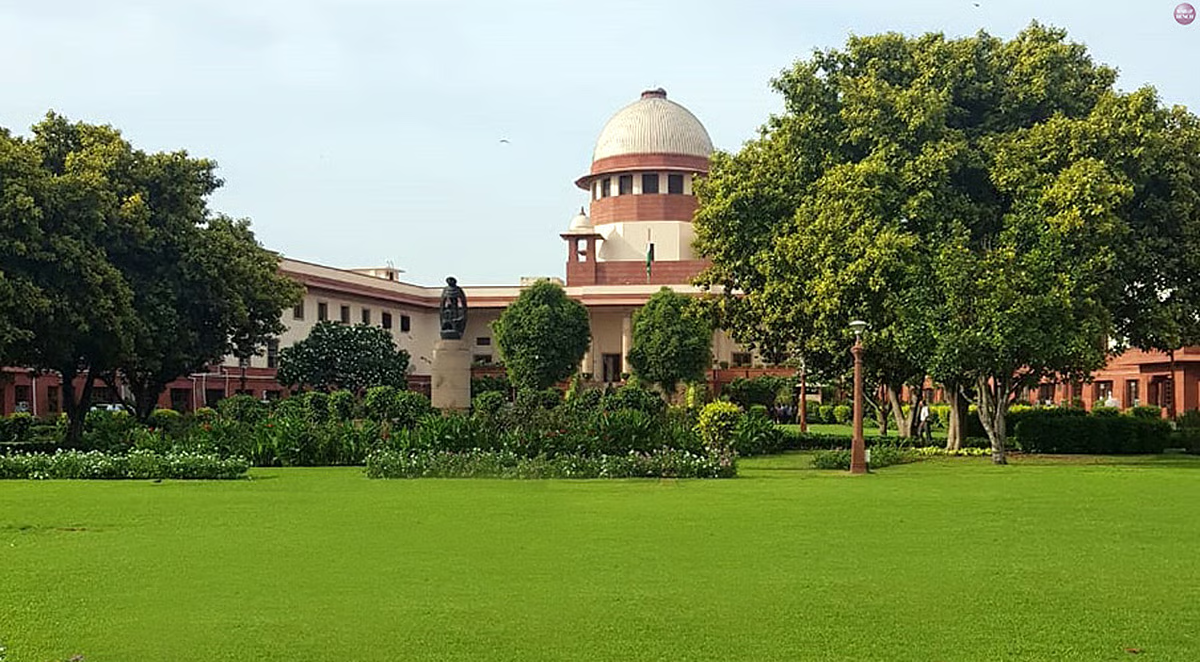
The Supreme Court has held that a temple trust does not qualify as an “industry” under Section 2(j) of the Industrial Disputes Act, 1947, and therefore provisions of the Act governing industrial disputes ordinarily do not apply to such religious institutions. The judgment was delivered in an appeal by a longtime employee of a temple trust who challenged earlier findings that the trust was not an industry.
Background
An accountant employed by the Laxminarayan Dev Trust had worked continuously for more than twelve years before his services were terminated orally without a formal inquiry. The Labour Court held that the temple trust, being a religious and charitable institution, did not fall within the statutory definition of an industry because it did not engage in manufacturing or profit-making activities. This view was upheld by the Gujarat High Court before the matter reached the Supreme Court.
Court’s Reasoning
The Supreme Court agreed that a temple trust — especially one primarily focused on religious functions and charitable activities — cannot be brought within the “four corners” of the definition of industry under the Industrial Disputes Act. The Bench noted that religious institutions without commercial objectives do not engage in systematic activities organised for the production or distribution of goods or services in the economic sense contemplated by the Act.

Relief to the Employee
Although the Court did not treat the trust as an industry, it took into account the employee’s long and uninterrupted service and the procedural lapse in his termination. In the interests of justice, it directed the trust to pay ₹12,00,000 as lump-sum compensation as a full and final settlement of all claims, inclusive of interest, to be paid within a specified period.
Significance
This decision reinforces that the ambit of labour protections under the Industrial Disputes Act does not automatically extend to religious and charitable trusts solely on the basis that they employ workers. However, the Court’s willingness to award compensation for unfair treatment underscores that equity and fair treatment of employees remain important, even outside the Act’s coverage.
