



Introduction
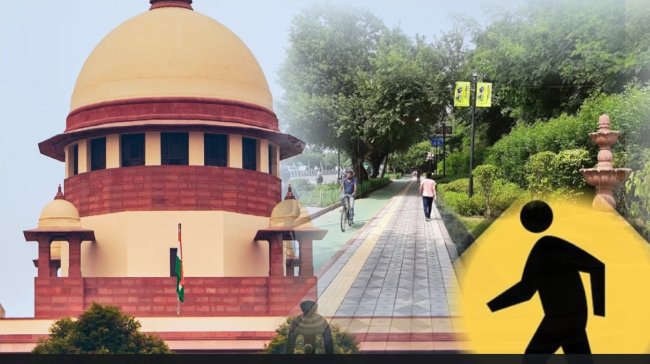
In a landmark judgment on pedestrian rights and urban infrastructure, the Supreme Court has declared that citizens have a fundamental right to walk safely on demarcated footpaths. The Court emphasized that the convenience of motorists cannot come at the cost of pedestrian safety and mobility. The ruling recognizes walking as an essential component of constitutional freedoms and places a corresponding duty on authorities to provide safe and accessible pedestrian infrastructure.
Background of the Case
The Supreme Court was considering issues relating to pedestrian safety, inadequate footpath infrastructure, and the dangers faced by citizens who are often forced to walk on roads due to the absence of proper walkways.
The Court noted that lack of safe pedestrian spaces exposes people to accidents and undermines their ability to move freely and safely in public spaces. These concerns prompted the Court to examine the constitutional dimensions of the right to walk.
Court’s Key Observation
The Supreme Court held that:
- The right to walk on a demarcated footpath is a fundamental right.
- Pedestrian rights must receive priority over the movement of motor vehicles.
- Urban planning and road infrastructure must accommodate pedestrians as primary users of public spaces.
- Authorities cannot ignore the needs of pedestrians while designing transport systems.
The Court observed that roads are not meant exclusively for vehicles and that citizens have an equal right to use public spaces safely.
Constitutional Basis of the Right to Walk
According to the judgment, the right to walk flows from constitutional guarantees, including:
- Article 19(1)(d) – Freedom of movement throughout the territory of India.
- Article 21 – Protection of life and personal liberty.
The Court observed that meaningful enjoyment of these rights requires safe and accessible pedestrian infrastructure. A citizen’s freedom of movement cannot be effectively exercised if walking itself becomes dangerous due to the absence of proper footpaths.
Motorists Cannot Override Pedestrian Rights
One of the most significant aspects of the ruling is the Court’s assertion that pedestrian rights cannot be subordinated to vehicular convenience.
The Bench emphasized that:
- Road development policies must not prioritize vehicles at the expense of pedestrians.
- Public authorities must ensure that footpaths remain usable and safe.
- Encroachments, obstructions, and inadequate maintenance of footpaths undermine constitutional rights.
The Court made it clear that motorized traffic cannot negate the basic right of citizens to walk safely.
Directions for Better Pedestrian Infrastructure
The Supreme Court highlighted the need for governments and local authorities to take proactive measures to improve pedestrian infrastructure.
The judgment stressed:
- Creation of well-demarcated footpaths.
- Removal of encroachments obstructing pedestrian movement.
- Development of accessible walkways for persons with disabilities.
- Adoption of policies that prioritize pedestrian safety.
The Court also emphasized that proper footpaths are not merely an urban planning feature but an important component of constitutional governance.
Importance of the Ruling
This judgment is significant because it:
- Recognizes walking as a constitutionally protected activity.
- Strengthens the rights of pedestrians in urban and rural areas.
- Places greater responsibility on governments and municipal authorities to create safe public infrastructure.
- Reinforces the principle that public roads must serve all users, not only motorists.
Impact on Urban Development
The ruling is expected to influence future road planning and urban development policies across the country.
Authorities may be required to:
- Give greater attention to pedestrian-friendly infrastructure.
- Ensure compliance with accessibility standards.
- Reduce encroachments on sidewalks and walkways.
- Incorporate pedestrian safety into transportation planning from the outset.
Conclusion
The Supreme Court’s decision marks a significant advancement in the recognition of pedestrian rights in India. By holding that the right to walk on a demarcated footpath is a fundamental right and that motorists cannot override this entitlement, the Court has reinforced the constitutional principles of dignity, safety, and freedom of movement. The judgment underscores that truly inclusive public infrastructure must prioritize the needs of pedestrians alongside all other road users.
