



Introduction
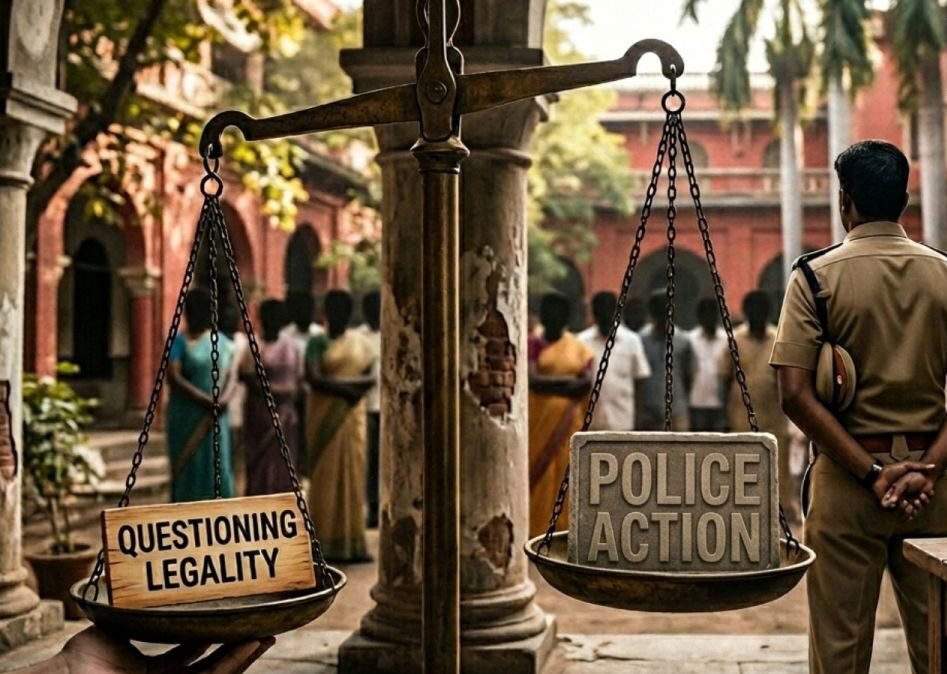
In a significant judgment safeguarding individual liberty and freedom of expression, the Madras High Court has held that criminal law cannot be used as a tool to silence citizens merely because they question the legality of police action.
The Court observed that while police officers performing lawful duties deserve protection, mere questioning, protest, or verbal disagreement with police actions does not automatically constitute a criminal offence.
Background of the Case
The case involved two individuals against whom an FIR and subsequent criminal proceedings had been initiated on allegations that they abused, obstructed, and intimidated a police officer during the discharge of official duties.
The accused approached the High Court seeking quashing of the proceedings, contending that the allegations were vague and that the case had been registered without sufficient legal basis.
Court’s Key Observation
The Madras High Court emphasized that:
- Citizens have the right to question the legality of police actions.
- Mere verbal protests or disagreements with police officials cannot automatically attract criminal liability.
- Criminal prosecution must be based on clear evidence showing that the legal ingredients of the alleged offences are satisfied.
The Court stated that the decisive issue is whether the available material actually discloses obstruction, assault, intimidation, or any other offence recognized by law. In the absence of such material, criminal proceedings cannot be sustained.
Examination of the Allegations
After examining the investigation records and final report, the Court found that:
- The allegations were largely general and lacked specific details.
- No clear material showed wrongful restraint of the police officer.
- There was no specific act indicating assault or use of criminal force.
- The prosecution failed to establish a real and serious threat amounting to criminal intimidation.
The Court observed that simply questioning a police officer or objecting to an enquiry does not, by itself, amount to a criminal offence.
Protection of Citizens and Public Servants
The High Court clarified that:
- Public servants must be protected when carrying out lawful duties.
- At the same time, citizens cannot be prosecuted merely for challenging or questioning official actions.
- Courts must carefully examine whether the essential ingredients of alleged offences are actually present before allowing a prosecution to continue.
The judgment highlights the need to balance governmental authority with constitutional freedoms.
Court’s Decision
Finding that the prosecution materials failed to disclose the essential elements of the offences alleged, the Madras High Court quashed the criminal proceedings against the accused.
The Court held that forcing individuals to undergo a criminal trial in such circumstances would amount to an abuse of the legal process.
Importance of the Ruling
This judgment is significant because it:
- Reinforces citizens’ right to question government action.
- Prevents misuse of criminal law to suppress dissent or criticism.
- Emphasizes the requirement of specific evidence before prosecution.
- Protects both civil liberties and the rule of law.
Conclusion
The Madras High Court has reaffirmed that questioning police conduct, without more, cannot be treated as a criminal act. By quashing the FIR, the Court emphasized that criminal law must be used to address genuine offences and not as a means to discourage citizens from seeking accountability from public authorities.
