



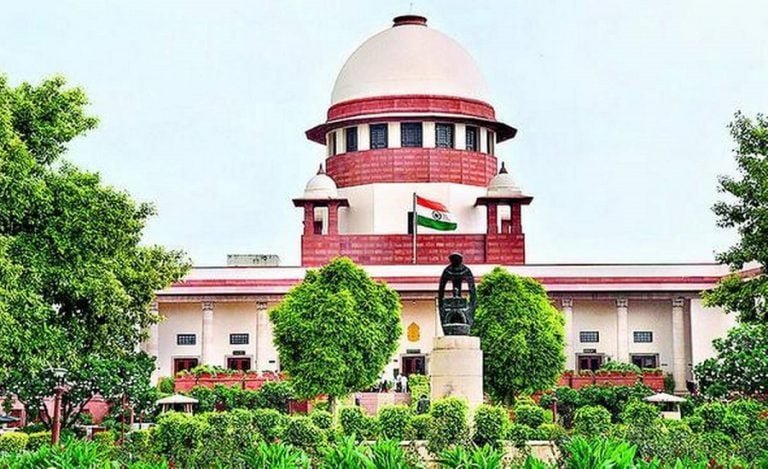
The Supreme Court has held that elected representatives cannot use their public mandate as a source of personal authority or unbridled power to command, intimidate or enforce their own will. The Court observed that an elected representative is required to work within the framework of law and cannot assume the functions of the police, administration or judiciary.
A Bench comprising Justice Vikram Nath and Justice Sandeep Mehta made these observations while setting aside the bail granted to a Kalyan-Dombivli Municipal Corporation corporator and three others accused of allegedly assaulting and verbally abusing doctors and medical staff at a municipal hospital.
Background Of The Case
The case arose from an incident in July 2026, involving Kalyan-Dombivli Municipal Corporation corporator Ramesh Sukrya Mhatre and three other accused.
According to the allegations, the accused assaulted and verbally abused three doctors, including a woman doctor, while they were on duty in the labour ward of a municipal hospital. The incident reportedly followed a dispute concerning the shifting of a pregnant woman who was in labour.
The Maharashtra Government challenged the Bombay High Court’s decision granting bail to the accused. The State argued that the High Court had earlier taken a different prima facie view while staying the Magistrate’s bail order but subsequently granted bail without identifying any material change in circumstances.
Supreme Court Questions Use Of Political Influence
The Supreme Court expressed serious concern over situations where persons holding elected office consider the people’s mandate as giving them personal authority to command or intimidate others.
The Court emphasised that an elected representative is entrusted with the responsibility of serving the public and strengthening institutions through which grievances are addressed and justice is administered.
The Court made it clear that such a representative cannot replace or interfere with these institutions by assuming the role of the police, administrator or Court.
The Bench observed that democracy provides authority through the ballot, but the exercise of that authority remains subject to the discipline of law.
Authority Of Elected Office Is Not Above Law
The Supreme Court further observed that the constitutional framework distinguishes between authority legally conferred upon a public representative and personal influence exercised by an individual.
The Court stated that the authority attached to an elected office cannot be used as a basis for disregarding legal restrictions applicable to every citizen.
It also observed that using personal influence to obtain compliance through fear or intimidation can have consequences beyond the immediate victim and may undermine public confidence in the rule of law.
Assault On Medical Professionals Viewed Seriously
The Court gave particular importance to the fact that the alleged victims were doctors performing their duties.
Medical professionals often work with vulnerable patients and are required to take immediate decisions during medical emergencies. The Court observed that attempts to intimidate or assault doctors while they are performing their professional duties cannot be tolerated, particularly where the alleged acts involve persons holding elected office.
At the same time, the Court clarified that its observations do not provide medical professionals any immunity from accountability. Any allegation of negligence or failure to perform professional duties must also be dealt with strictly in accordance with law.
Criminal Antecedents And Witness Protection
While considering the bail issue, the Supreme Court also took note of the criminal antecedents attributed to the corporator. The Court noted that 18 cases had been registered against him, although he had secured acquittal or discharge in 16 proceedings.
The Court also considered the apprehension that his influence could affect material witnesses. Reports that some of the doctors had resigned or stayed away from duty because of fear were also taken into consideration while assessing the possibility of intimidation.
The Court directed that adequate protection be provided to material witnesses, particularly doctors and hospital staff, under the Maharashtra Witness Protection and Security Act, 2017.
Supreme Court Cancels Bail
The Supreme Court found that the Bombay High Court had adopted inconsistent approaches in its two orders without adequately explaining what circumstances had changed between them.
Accordingly, the Supreme Court set aside the High Court’s order to the extent that it restored the bail granted to the four accused by the Magistrate.
The accused were directed to surrender before the trial court on or before 5 October 2026. However, the Court granted them liberty to seek bail again if there was a material change in circumstances.
The Court also directed the Maharashtra Government to independently examine whether the provisions of applicable preventive detention laws were attracted.
Further, the Special Fast Track Court was directed to endeavour to conclude the trial expeditiously. The prosecution was asked to review its list of 64 witnesses and dispense with witnesses whose evidence was not necessary.
Key Legal Principle
The judgment reinforces an important constitutional principle: an electoral mandate gives a representative public responsibility, not unrestricted personal authority.
Elected representatives remain subject to the same legal framework as every other citizen. Political or public influence cannot be used to intimidate individuals, interfere with institutional processes or substitute personal decisions for the functions entrusted to the police, administration and judiciary.
The Supreme Court’s observations therefore underline the importance of maintaining institutional boundaries and ensuring that public office is exercised in accordance with the rule of law.
